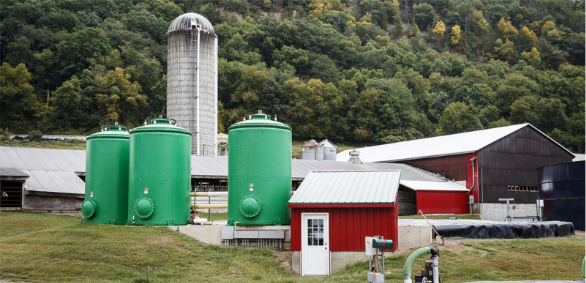
What happens when you do not finish your food at the dining hall? Or to the scraps leftover from preparing your favorite dish? It ends up at Barstow farm. The Barstow family has been farming land in Hadley since 1806. By the 1920s, the farm was primarily a dairy operation. But as time changed, the family adapted. In 2008, when the milk market hit one of its worst slumps in decades, the Barstows made the decision to diversify. Based on Shannon Barstow’s love of baking, the family opened Barstow’s Dairy Store and Bakery. Then in 2013, another change came to the farm — an anaerobic digester.
The zero-waste, closed-loop Farm Powered anaerobic digester on the farm converts the stored energy in farm and food waste into electricity, heat, and fertilizer. The farm receives more than 14,000 tons of food waste annually from food manufacturers, processors, and users such as Cabot Creamery and UMass. At UMass, our food scraps take one more stop at the Agri-Cycle facility in Agawam for depackaging before heading to the digester. This prevents contamination from things like wrappers, plastic cutlery, and other inorganic materials. UMass sends 12,000 tons of food waste for anaerobic digestion every year.
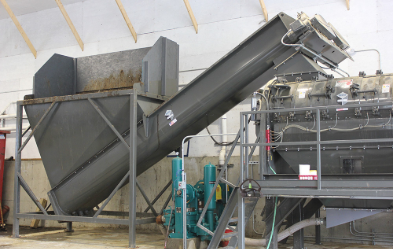
The food waste is combined with up to 9000 tons of manure each year in a 600,000-gallon anaerobic digestion tank. The tank operates much like a cow’s stomach. Microorganisms in the tank convert sugars, fats, and other compounds into biogas that powers a 300 kW engine annually producing more than 2,100 Mwh of electrical energy, 7,040 MMBTUs of thermal energy, and 30,000 tons of odor-free, organic, liquid fertilizer. The system also sequesters 85% of the greenhouse gases produced on the farm. The Farm Powered anaerobic digester also provides renewable energy to the surrounding community via the Eversource grid and to the Cabot Creamery/Agri-Mark Cooperative butter plant in West Springfield, Massachusetts. For more information,