
About a third of all human-caused greenhouse gas emissions are linked to food. Luckily, this means informed dining choices are one of the most effective and accessible ways for people to lower their personal emissions. But it can be daunting to feel like everything we eat contributes to global warming, especially with so much misinformation on what is sustainable and what is not. Is tofu driving deforestation? What is regenerative beef? It’s easy to fall down obsessive rabbit holes instead of focusing on the most effective big-picture dining habits.
Plant-based is the most sustainable, but eating smaller animals is the next best option
Regardless of whether you compare the footprint of foods in terms of calories or per gram of protein, the overall conclusion is the same. Plant-based foods tend to have a lower carbon footprint than meat and dairy. In many cases, a much smaller footprint.
This relationship tends to hold true over different production styles: the most unsustainably farmed tofu still emits less greenhouse gas than the most sustainably farmed beef. You may hear that soy is driving deforestation in parts of the world. This is true, but it’s for soy that is being used as animal feed. Only 7% of the world’s soy production goes directly to human consumption.
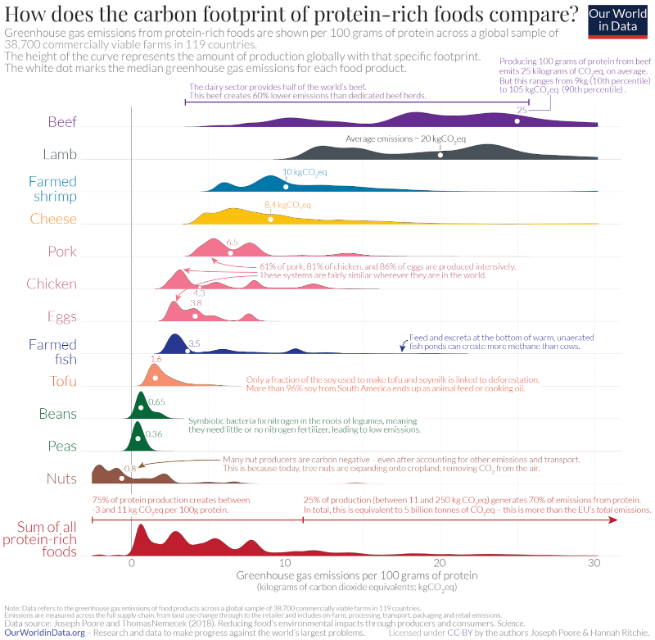
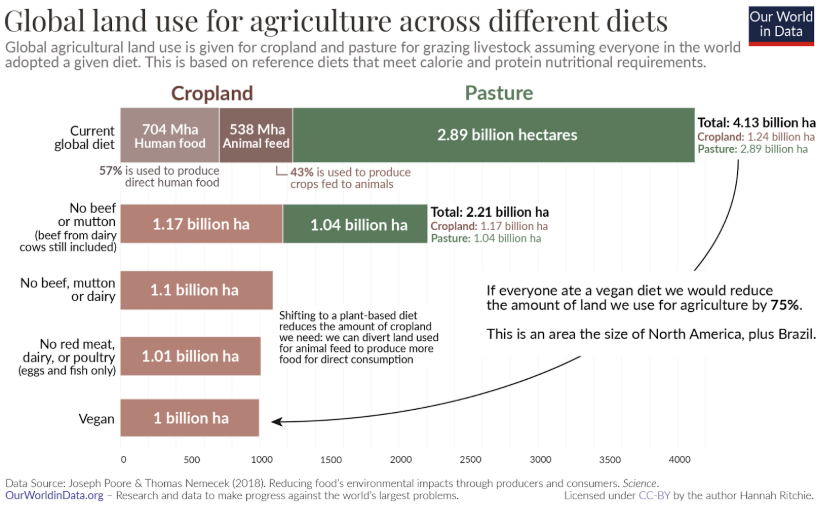
The next best option is almost always smaller animals, starting with fish and poultry and working your way up to mutton and beef. This is because smaller animals tend to be more efficient converters of protein that we them into the meat and dairy that we eat. As an example: beef has an energy efficiency of about 2%. This means that for every 100 kilocalories you feed a cow, you only get 2 kilocalories of beef back. In general, we see that cows are the least efficient, followed by lamb, pigs then poultry. To get a sense of the scale, we would half the amount of crop land we currently use if we stopped eating beef and mutton, even while still drinking dairy.
If you are ever unsure about the sustainability of your meal, or curious to compare the sustainability of your dining hall favorites, look for the carbon rating on the menu identifier card. The Carbon Rating System, powered by My Emissions, calculates the kgCO2e (carbon emissions per kg of product) for every menu item. My Emissions considers life cycle factors such as farming methods, processing and production, transportation distances, and packaging impact. It makes dining sustainably as easy as looking for the As, Bs and Cs on the menu cards.
For more information, see